|
||
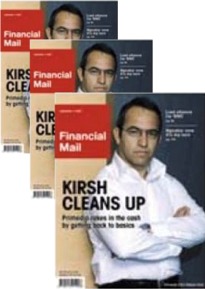 OLDER AND WISER |
||
|
The media company has regained its status among investors by learning its lessons William
Kirsh, Primedia's
CEO, is a little grey around the edges. Fittingly, he is more relaxed
than he has been in the past few years. He has the air of a wiser
man, one more circumspect and strategic in his thinking. The hunger that once typified and drove him is no longer there. There is a quiet, modest confidence in its place. Fortunately for Primedia shareholders, though, Kirsh's belief in his abilities as an entrepreneur remains part of his DNA. He could be a metaphor for the company he built, which was a precocious pretender to the JSE's ruling elite. Youthful zeal and exuberance counted for much of the value of Primedia then and the company bought its own hype. Primedia is a much more sedate creature than the hungry predator born with the listing of Radio 702 and two smaller media assets in 1994. In the five years following the listing, Primedia went on a spending spree - acquiring Ster Kinekor and Radio Highveld, among others - and became one of the largest JSE media companies . Today's Primedia is not quite the growth stock it was back then, when investors could see their capital double in a few months. But it is a cash-generating media machine, an energetic and innovative media house that understands its business is to give customers the best possible access to their market. Primedia is hot property again and investors have pushed the share price up by about 130% to R9,50 over the past 12 months. This time, it is based on operational substance and not the mad valuations of analysts believing their own propaganda. Primedia showed some sparkling results for the year ended June 2004. Revenue was up 4,8% for continuing activities, operating profit was up 63,3% and bottom-line profits were up by an impressive 724%. (See September 17 2004 Financial Mail.) Kirsh is modest about it, crediting the economy. It is true that much of the growth came from the group's advertising-reliant businesses, where growth was well into double digits. That modesty is understandable, but what the market is excited about is the cash flow statement. Cash from operating activities was up a strong 80% to R350m. More importantly, free cash flow was up 194%, while cash and cash equivalents in the balance sheet stood at R66m in June. In effect, the group is ungeared. Just a few years ago, Primedia lost out on acquiring Kagiso Media for about R300m - the equivalent of R3/share - because the banks, worried about its high debt, would not lend it the money. Kagiso would have been a good catch; it is trading at R7,50/share and generates lots of cash. But at least Primedia has transformed itself and is virtually debt-free. The turnaround story is one of rapid expansion gone bad, but also of a willingness to learn from mistakes and take painful corrective measures. In the mid-1990s Kirsh, an ambitious entrepreneur, had a vision of the new media environment in a democratic SA and he quickly acquired a publishing outfit and an outdoor media firm to go with his radio station. Then, with the backing of Rand Merchant Bank, which had bought his vision of a deregulated broadcasting environment , he waited to get a piece of the SABC. That didn't happen. Instead, radio has become his big game. He bought Highveld Stereo for what analysts said was far too much. The cash-spewing station has proven them wrong . Earlier this year Primedia increased its economic stake in Highveld from 55% to 86% for R120m. Highveld remains the largest contributor to Primedia's profits, accounting for 47% in the year to end-June 2004. Kirsh says Highveld remains a strong performer but he would like to see its share of profits diluted to around 25%-30% of the total. He also launched Cape Talk, a less successful venture which was meant to emulate 702. But talk radio was not as appealing as it had been and listeners had more choice than before. The margins at the two talk stations are fairly low by the standards of Highveld, which has 60% operating profit margins. The vision was to have a diversified media company, underpinned by critical mass in quality radio, with a range of assets that would serve to spread the risk and earnings cycles of different media products and environments. Kirsh says Primedia is still one of the most diversified media companies. "What we try to do is benchmark ourselves against the best media companies. The best are diversified but with strategic intent. So they have different platforms but they are trying to make these platforms work with each other." Synergy and convergence are terms that became associated with Kirsh in the late 1990s and the early 2000s. They have since been somewhat discredited in the media industry, though they are making a more sober comeback. Kirsh continues to believe in diversified platforms and critical mass. His quest for these led to arguably his worst acquisition, a range of movie businesses from media group Interleisure, including Ster-Kinekor Theatres. In 1997, when he bought the business, analysts thought R1,5bn was too much to pay. "There were doubts about the price," says one, "because of the size of the market and whether it would grow sufficiently ." He was partially right: Ster-Kinekor in SA was overcapitalised but has recently turned around after years of losing market share. The real disaster was the foreign adventure his new cinema business would lead to. Like most traditional SA businesses, Primedia believed back then that the only route out of a saturated, white SA market was to expand overseas. The pressure that the underperforming local movie business was placing on the share price also forced Kirsh's hand. It was to be his folly. Ster Century Europe was a costly exercise that weighed on Primedia's balance sheet. The first complex, Liffey Valley in Ireland, did well . "It was a fool's paradise from day one," says Kirsh. "It's still doing exceptionally well today."
|
Buoyed by that success, Primedia decided the secret was to be first in the territory and achieve critical mass. And so there was a simultaneous push into a number of new countries. Unfortunately these operations didn't do quite so well relative to costs. It began to show in the company's return on capital. The fall of the empire was as swift as its rise. The global dot-bomb - the sharp share-price correction of technology, media and telecommunications stocks - and a wobbly SA economy in which advertisers cut spending brought the company back to reality. From a high of R48 in 1998 the share price traded as low as R3 three years later. Primedia and Kirsh were forced into some serious introspection. "The irony," says Kirsh, "is that at the height of the company's share price, we were at our weakest. We didn't have breadth of operational capacity." It was a wake-up call and one that Kirsh now credits with the beginning of the turnaround of the company. In 2000, when Ster Century was draining the group, UK fund managers Active Value thought it was a good time to strike and wrest control of the company from the Kirsh family. With his back against the wall, Kirsh made some crucial decisions about his role in the company and Primedia's shareholding structure. He extracted himself from the day-to-day management and handed the troubled film businesses to Ferdi Gazendam of Teljoy fame. Kuben Pillay, the executive in charge of strategy, was given control of the advertising operations. Pillay had handled Primedia's empowerment deal with the Mineworkers' Investment Co (MIC), his ultimate bosses. The alliance between MIC and the Kirsh family, who combined hold a 43% voting stake in Primedia, ultimately defeated the Active Value raiders. MIC has played a strong role in the business, unusual for an investing empowerment company, and has invested R100m of its own funds in Primedia. Kirsh says Pillay was put in charge of the advertising businesses to allow him to look at the overall business from a strategic perspective. Pillay was also asked to find fresh horizons for the business, which was reaching maturity. "As I reflected on where Primedia needed to go," says Kirsh, "I decided to bring Kuben in. I've talked the synergy game. But Kuben made it happen." This allowed Kirsh to focus on disposing of the European operations. Primedia's financial position improved rapidly. Meanwhile Pillay was quickly able to put his stamp on the advertising businesses. It was Pillay who achieved synergy and co-operation across the various media platforms. Pillay says the result was that in the year to end-June 2004 the group made an additional R25m in advertising by selling across the different platforms. Pillay was also instrumental in growing the below-the-line advertising businesses, such as Commuter Media, which includes ComutaNet, the transport branding and advertising business, and Rank TV, which places televisions at SA's taxi commuter ranks. This and Rank Branding have both grown explosively - the commuter media division's contribution to profits has doubled in the past year . The group sees the future of advertising as out of the home. Simply put, there are too many distractions in people's homes and audiences have become fragmented. Another lesson Kirsh says he learnt was to focus on the market Primedia knew best - SA. "Though it is a smaller market, we have depth of management." Pillay says Kirsh's move from operational management to a more strategic position was crucial. This allowed Kirsh to look at acquisition opportunities, especially the key media assets sold by New Africa Investments earlier this year. Among them were the cash-rich Cape radio station KFM and Nail's outdoor business . "The Nail deal could never have happened if William had been involved in day-to-day operations," says Pillay. Kirsh agrees: "It was a complex deal and it took up a lot of my time." Once again, the partnership with MIC proved useful. Primedia had initially approached Investec to lead the Nail deal, but realised that this strategy would fail when rival media firms Caxton, Johncom and Kagiso teamed up to bid for all the Nail assets. Unlike the consortium, Primedia could not afford to buy all Nail's media assets. Instead it teamed up with Investec and the Tiso Group to buy the entire company, with Primedia taking up certain of the Nail assets. Then Primedia pulled out of the picture and brought MIC into the deal. The idea was to get the help of an empowerment partner in the consortium and to give MIC an upside on the transaction, profits which the company then had an option to reinvest in Primedia as part of building up its stake. Primedia has transformed fundamentally over the past few years. Most JSE analysts, polled by I-Net Bridge, suggest an accumulation of the share. Yet some niggling issues persist. Like most media companies, Primedia's top-line growth is sluggish and is likely to remain so in an economy growing only moderately, with low inflation. Kirsh points to evidence that adspend over the past 10 years has consistently grown faster than inflation and GDP . Still, the ad market has been volatile, and the challenge is to find new markets. One that has not been thoroughly explored, particularly in the cinema business, is black movie-goers. Kirsh says the company is paying attention. "This past year is not one where we could boast about breaking into the black consumer market in terms of financial returns. But we are gaining experience and should see some growth in that area. " Another big push is in home entertainment. The falling cost of DVDs has led to rapid growth in the market and Primedia has opened three shops to test the home market. The African continent is also featuring on the strategic horizon, with outdoor advertising showing the road into a market where risk is high but so are potential returns. This time, the company will remember what it learnt about expansion in Europe. And, more importantly, it is operating from a solid base that has once again established Primedia as one of SA's most solid media companies. 17 September 2004 |
|